Arrest of Anne's food supplier
Diary of Anne FrankThe arrest of Anne’s food supplier is a turning point in the daily struggle to keep the Secret Annex fed: it removes a crucial source of provisions and exposes how closely the residents’ survival depends on helpers beyond their hiding place. Anne presents the arrest not as an isolated misfortune but as a personal loss, a supply crisis, and another pressure on an already fragile network of concealment.
The arrest and its human cost
Anne reports that the police have arrested a man whose name she chooses not to write down. He had been supplying the residents with potatoes, butter, and jam. The withheld name reflects the danger surrounding the people who help them, while the list of foods gives the arrest an immediate material consequence: a trusted route to necessities has been cut off.
The supplier’s exposure is especially distressing because of his family. Anne notes that he has five children under thirteen and another child on the way. Her account thus places the danger beyond the Annex: the man’s arrest threatens not only those who depended on his deliveries but also a household with several young children and an expected baby.
A fragile supply network
The arrest compounds other disruptions among the helpers. At the time, Miep is ill after catching cold at a wedding, and Mr. Kleiman has again been kept from work by stomach bleeding. Bep is left to manage the shop alone, making it harder to maintain the residents’ shopping arrangements. The arrested supplier’s role therefore matters within a broader network already weakened by illness and absence.
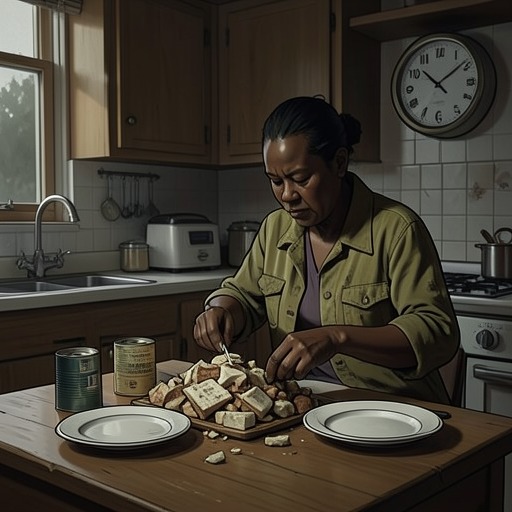
Anne later explains the immediate rationing consequences: the residents have only five black-market ration books and no coupons for fats and oils. With Miep and Mr. Kleiman sick again and Bep unable to manage the shopping, food has become wretched and the residents feel the strain. The loss of the supplier’s deliveries is not simply a change of menu; it sharpens the Annex’s reliance on scarce, illicitly obtained supplies and on a handful of people who can reach the outside world.
From persecution to daily constraint
The crisis belongs to the larger system of anti-Jewish restrictions Anne describes. After the German occupation, decrees restricted Jews’ movement, shopping hours, transport, schooling, and access to public life. When the Frank family went into hiding, their plan had already been brought forward because Margot received a call-up notice; they entered the concealed rooms in Otto Frank’s office building, dependent on informed helpers while warehouse workers nearby knew nothing of their presence. Against that background, the supplier’s arrest threatens both food access and the fragile arrangements that make concealment possible.
The diary records this pressure through specific domestic effects rather than abstract statements about scarcity. Potatoes, butter, jam, ration books, and missing coupons become the practical measures of safety and dependence. In a later security scare, the residents impose tighter precautions: Peter patrols the house, the toilet cannot be flushed after half past nine, and a carpenter from the underground is to build a barricade from white Frankfurt bedsteads. These measures do not follow directly from the supplier’s arrest, but they show the wider climate in which every outside connection and every ordinary household routine carries risk.
Significance in the diary
Anne’s account holds together sympathy for the arrested man and awareness of the consequences for the people in hiding. She is terribly upset for the “poor, good-hearted Mr. M.,” yet admits that there is little room for him in her diary when she is absorbed in her own concerns. The contrast is revealing: compassion persists, but confinement and scarcity repeatedly pull attention back toward immediate survival.
The arrest also makes visible the human cost of the Annex’s apparent refuge. The residents’ safety depends on assistance that cannot be treated as secure: a supplier can be taken by the police, helpers can fall ill, and provisions can disappear. By tracing the chain from arrest to missing coupons and worsening meals, Anne’s diary shows how persecution reaches into the most ordinary acts of eating, shopping, and caring for a family.